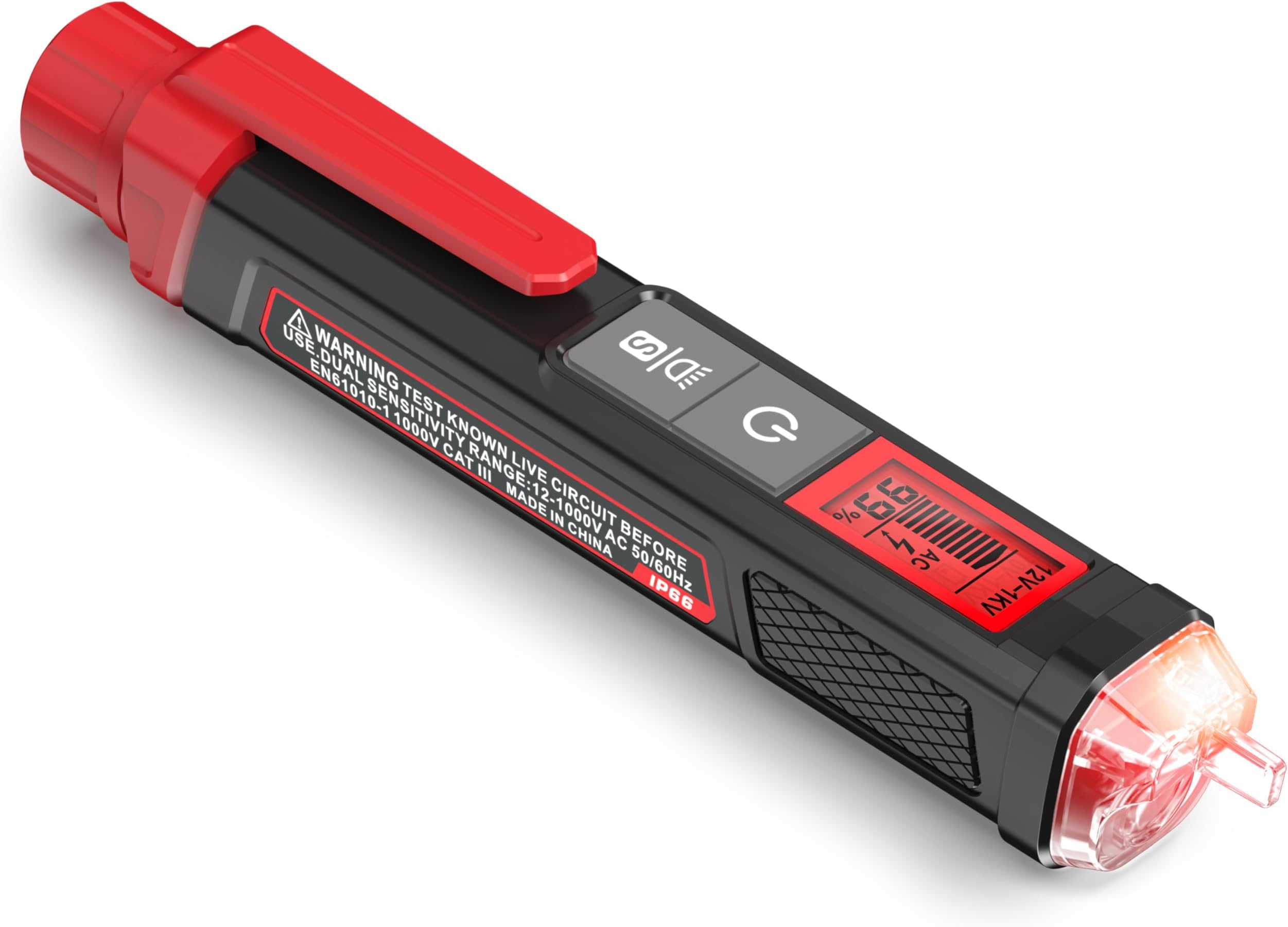
KAIWEETS Non-Contact Voltage Tester When dealing with electrical work, safety is the absolute highest priority. A reliable non-contact voltage tester is a mandatory tool for any toolbox, allowing you to check for live wires before performing any repairs or installations. The KAIWEETS Non-Contact Voltage Tester attempts to provide professional-grade safety features, featuring a clear LCD display, visual and audible alerts, and dual-range sensitivity. After evaluating its design and functional capabilities, here is how this electrical tester performs. The Verdict The KAIWEETS Voltage Tester is an exceptional safety tool that offers peace of mind for both DIY homeowners and professionals. Its dual-range detection capability makes it highly versatile, allowing it to safely identify standard household voltage as well as lower-voltage systems. With a clear visual display and loud audio cues, it leaves no room for guesswork when identifying live wires. Final Score: 4.6 out of 5 Detailed Performance Breakdown 1. Safety and Dual-Range Detection The standout feature of this tester is its dual-range selection capability. It can detect standard AC voltage from 70V to 1000V, which is ideal for household outlets, light fixtures, and circuit breakers. Additionally, it can switch to a high-sensitivity mode ranging from 12V to 1000V, making it highly effective for testing low-voltage systems such as doorbells, thermostats, and security wiring. 2. Visual and Audible Alerts KAIWEETS has built multiple layers of communication into this device so you can clearly understand the readings. The tester features a bright LCD screen that indicates signal strength, changing color based on the intensity of the voltage detected. This is paired with a distinct buzzer alarm that increases in frequency as you get closer to the live source, ensuring you can accurately identify live wires even in dark or noisy environments. 3. Live and Null Wire Testing Distinguishing between a live wire and a neutral null wire can be tedious. This tool simplifies the process by flashing red and beeping rapidly when placed near a live wire, while remaining green or showing a weaker signal next to a neutral wire. The pointed tip design also allows it to fit easily into individual slots of standard electrical outlets. 4. Form Factor and Usability The tool is styled in a high-visibility black and red casing and is shaped like a thick pen, complete with a pocket clip for easy carrying on a tool belt or shirt pocket. It is durable enough to handle standard toolbox wear and tear. Note that the unit runs on standard batteries which are not included in the retail box, so you will need to supply your own before the first use. Pros * Dual Range Testing: Easily switches between standard voltage and sensitive low-voltage environments. * Clear LCD Interface: Visual screen display takes the guesswork out of reading signal strength. * Loud Buzzer Alarm: Audio alerts provide immediate confirmation of hot wires. * Pointed Tip Design: Fits cleanly into standard wall socket terminals for direct testing. Cons * Batteries Not Included: Requires separate procurement of batteries before you can operate the device. * High Sensitivity Mode behavior: The low-voltage setting is highly sensitive and can occasionally pick up ambient static from closely bundled wires. * Pocket Clip Plastic: The plastic clip requires gentle handling to prevent snapping over time. Who is this for? * DIY Homeowners: An affordable and essential safety tool for anyone replacing light switches, outlets, or ceiling fans. * Professional Electricians: A reliable, lightweight backup tester for quick troubleshooting inside breaker panels. * Low-Voltage Technicians: Excellent for those who regularly service doorbell lines, thermostats, and smart home hardware.