


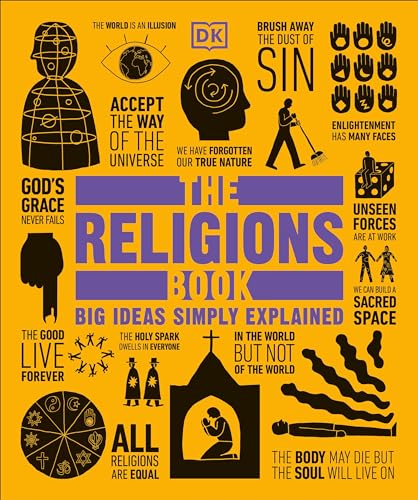


📖 Discover the Divine: Your Passport to Global Beliefs!
The Religions Book: Big Ideas Simply Explained is an extensive guide that delves into the beliefs, practices, and histories of over 50 world religions, presented in an engaging and visually appealing format. With more than 300 pages of simplified concepts, this book is perfect for anyone looking to enhance their cultural literacy and foster meaningful discussions.





















| Best Sellers Rank | #33,319 in Books ( See Top 100 in Books ) #18 in General History of Religion #19 in History of Religions #34 in Religion Encyclopedias |
| Customer Reviews | 4.6 4.6 out of 5 stars (1,503) |
| Dimensions | 7.81 x 0.84 x 9.19 inches |
| Edition | Illustrated |
| ISBN-10 | 1465476466 |
| ISBN-13 | 978-1465476463 |
| Item Weight | 2.12 pounds |
| Language | English |
| Print length | 352 pages |
| Publication date | November 13, 2018 |
| Publisher | DK |
K**S
Informative and easy to read.
I found this book to be well organized and easy to follow. There was a lot of new information for me so I expect to read it a second time.
E**H
Excellent Resource.
This book gives a clear, comprehensive overview of most major religions, making it an excellent reference for both kids and adults. We’ve found it especially helpful for homeschooling perfect for answering questions and sparking deeper conversations. Before we travel, we love using it to learn a little more about the culture we’ll be visiting. Easy to use, well-organized, and a wonderful resource to have on the shelf!
E**T
Sides of a Die
This is a collection of the world’s most common and historical religions. Reading the encyclopedic text shows us that from the beginning of humankind there has been a belief in the spiritual and supernatural. By analyzing different cultures and geographic regions a picture that when compartmentalized appears conflicting; but, when put on display all at once shows how similar the spiritual beliefs are to one another. Religions fit like different puzzle pieces to the same puzzle or different sides of the same dice. Most lead to the divine (usually a Creator) and include beliefs in a continuance of life after death; whether eternal life or reincarnation. The path of leading a moral (one of self improvement) is similar in the differing religions: to practice peace, to love one another despite differences, to help the unfortunate, and to play a role in creating a compassionate society seems to be the collective goal. By living simply, fairly, and in awareness that there is more meaning to life than individualism and materialism, as secular culture leads many to believe, shows us that there is truly one path that arises above all. As a Christ follower I share the following passage despite an evil agenda to divide brother from brother, despite ideological or theological differences; the day will come when we face death. A day that no matter belief is scientific recognition. So live a life of betterment. A favorite passage is found in Matthew 25: (I believe that by accepting this way of life a moral way is without prejudice despite differences that whether known in words but through actions God will judge and not by religious belief. “Blessed are the peacemakers) 32 All the nations will be gathered before him, and he will separate the people one from another as a shepherd separates the sheep from the goats. 33 He will put the sheep on his right and the goats on his left. 34 “Then the King will say to those on his right, ‘Come, you who are blessed by my Father; take your inheritance, the kingdom prepared for you since the creation of the world. 35 For I was hungry and you gave me something to eat, I was thirsty and you gave me something to drink, I was a stranger and you invited me in, 36 I needed clothes and you clothed me, I was sick and you looked after me, I was in prison and you came to visit me.’ 37 “Then the righteous will answer him, ‘Lord, when did we see you hungry and feed you, or thirsty and give you something to drink? 38 When did we see you a stranger and invite you in, or needing clothes and clothe you? 39 When did we see you sick or in prison and go to visit you?’ 40 “The King will reply, ‘Truly I tell you, whatever you did for one of the least of these brothers and sisters of mine, you did for me.’ 41 “Then he will say to those on his left, ‘Depart from me, you who are cursed, into the eternal fire prepared for the devil and his angels. 42 For I was hungry and you gave me nothing to eat, I was thirsty and you gave me nothing to drink, 43 I was a stranger and you did not invite me in, I needed clothes and you did not clothe me, I was sick and in prison and you did not look after me.’ 44 “They also will answer, ‘Lord, when did we see you hungry or thirsty or a stranger or needing clothes or sick or in prison, and did not help you?’ 45 “He will reply, ‘Truly I tell you, whatever you did not do for one of the least of these, you did not do for me.’ 46 “Then they will go away to eternal punishment, but the righteous to eternal life.”
G**E
Not exactly right.
Just received the book, “The Religions Book”, “ Big ideas Simply Explained”, and after a cursory review I would give the book a B-. The book gives a synopsis of various religions both past and present. The actual issue that I ran into was on page 334. While the paragraph at the beginning of the page appears concise, the material afterwards about The Roman Catholic Church and the Eastern Orthodox Churches is a bit misleading because of the language/grammar used. The author(s) state that the Roman Catholic Church originates during the 1st century CE, and that the Eastern Orthodox Churches originate from 1054. Not so. This is technically not correct. Both Churches stem from Christ and His Apostles during the 1st century. In the beginning there was only one Church and that was the Christian Church. The Churches were; the Church of the West (Substantially centered in Rome) and the Church of the East centered in Constantinople. But even before we can speak of “centers”, of the entire Christian Church, the Church was united through Faith and the Ecumenical Counsels until the Great Schism of 1054. Until that time the Christian Church was fully Catholic (Catholic means Universal), which the Church was considered universal as to one teaching. Why was there a Schism? Various reasons developed between the East and Western Church. One was the use of statues used within the Western Church. The other was the use of Icons by the Eastern Church. The Schism also developed over the use of the Church of the West (Rome) adding the Filioque to the “Creed”. The Creed is and still remains within the Eastern Orthodox Church unchanged and a statement of Faith. The term Filioque meaning “and through the Son” was not used in the original Creed developed during the 1st and 2nd Ecumenical Counsels but added by the Church of the West. One my wonder why would simply changing a single short line in the Creed be so important? The answer is more important than just a few simple words. Adding the Filioque to the Creed posed a very real problem. The Filioque, and the part of the Creed where it was inserted, addresses the how the Holy Spirit proceeds from within the Triune God head of Christianity, the Father, Son and Holy Spirit. In inserting the Filioque stating the Holy Spirit proceeds from the Father (and the Son) causes a major problem within the Christian Church. The issue stems from the baptism of Christ, by John the Baptist. The Holy Spirit descended upon Christ, in the form of a dove, while he was being baptized in the Jordan River by John The Baptist. If the Holy Spirit proceeds from the Father “and the Son”, this would mean that Christ sent the Holy Spirit unto Himself, which would negate the baptism of Christ. Additionally the first two Holy Ecumenical Councils of the ENTIRE Christian Church composed the Creed and it was agreed by the entire Christian Church, both Eastern and Western, that the Creed would not be changed under any circumstance. The Creed is a statement of Christian Faith for the Entire Christian Church. Getting back to the differentiation on page 334. Both the Roman Catholic Church and the Eastern Orthodox Church have the same origins within the time line beginning with Christ and His Apostles. So I feel that the book overall may be in question, or slanted one way or the other, for the different religions that are addressed. I will attempt to update this review in the future.
D**E
Interessant um sich zu erweitern
R**T
This series is excellent. This one is good for understanding religions around the world. Well written with simple illustrations.
M**L
this book is 1000000% worth it. super informative and v easy to follow
I**Y
Bu eserin Türkçesini daha önce edinmiştim, İngilizcesini de kitaplığımıza ekledim.
M**Y
Assez exhaustif mais trop centre sur les religions monotheistes. J'aurais apprécié plus de détails sur d'autres croyances ( religions océaniques ...)
Trustpilot
5 days ago
2 days ago


